
Learn Online with a One-to-One Quran Tutor
Build a strong Quran reading foundation with personalised one-to-one online Noorani Qaida classes for children, adults and complete beginners. Learn the Arabic letters, correct pronunciation and confident reading of Quranic words, step by step.
- 3,500+ Students Worldwide
- Serving 50+ Countries
- Certified Male & Female Tutors
What Is Noorani Qaida?
Noorani Qaida, also known as Qaida Noorania, serves as the standard primer for learning to recite the Quran. This book guides beginners through Arabic letters, their correct pronunciation, and foundational reading rules, moving step-by-step from individual characters to whole Quranic words.
It functions essentially as the initial alphabet and phonics phase of Quranic education. Before moving on to fluent recitation, students must first master the recognition and proper sounding of each letter, as well as the ability to combine them using appropriate vowels. Noorani Qaida systematically develops these essential skills, making it the universally recognized first step for anyone starting their journey into Quran learning.



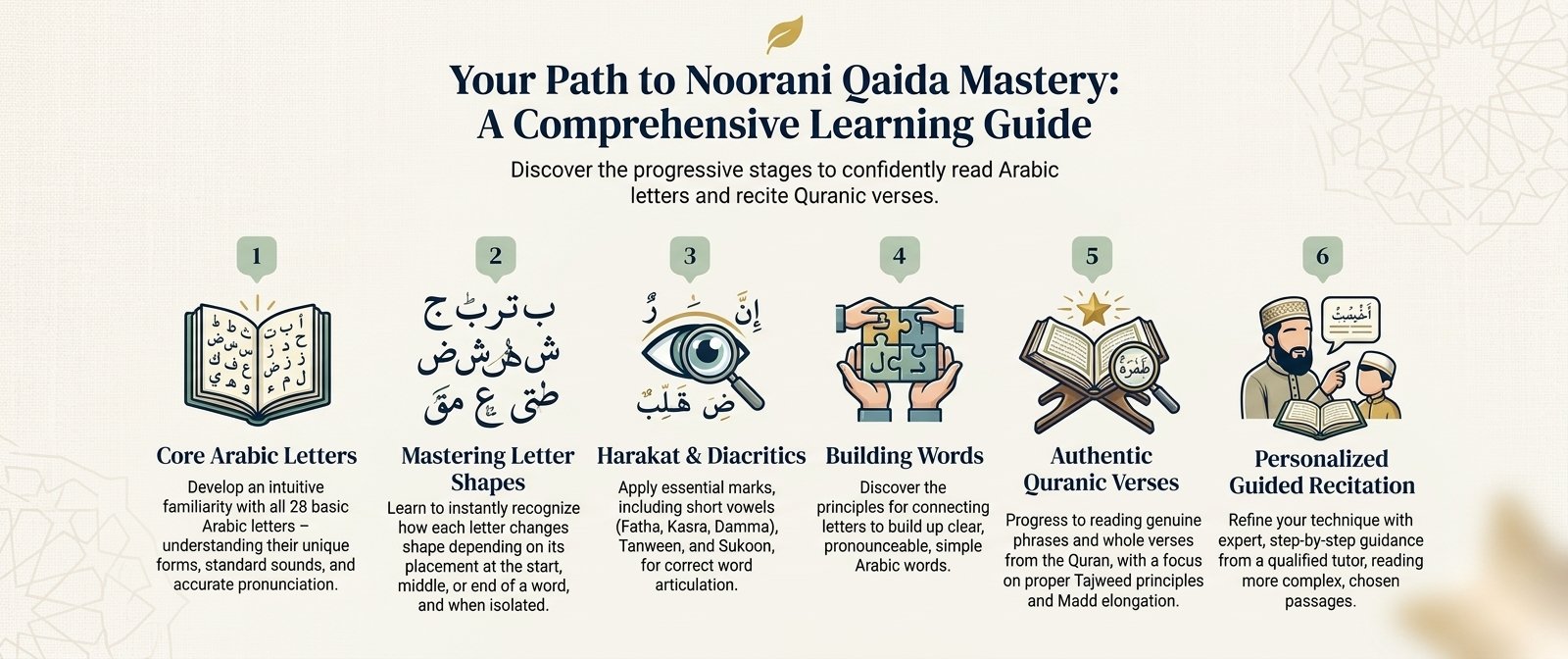
Inside the Course: A Step-by-Step Curriculum
1 The Arabic Alphabet & Letter Shapes
Start by learning all 28 Arabic letters—their names, sounds, and shapes. Because Arabic letters change their shape depending on where they sit in a word, you will practice reading them at the start, middle, end, or when standing alone.
2. Correct Sound & Pronunciation (Makharij)
Learn the exact spot in your mouth or throat where each letter sound comes from. Getting this right from the beginning stops common mistakes and makes your reading clear and accurate.
3. Short Vowels (Harakat)
Short vowels bring the letters to life. You will learn the three main vowel sounds:
Fathah: Makes a short "a" sound
Kasrah: Makes a short "i" sound
Dammah: Makes a short "u" sound
4. Important Reading Marks (Tanween, Sukoon, & Shaddah)
Learn the extra marks that shape words in the Quran:
Tanween: Doubled vowels that end with an "N" sound.
Sukoon: A resting mark that means a letter has no vowel.
Shaddah: A mark that means you press harder on a doubled letter.
5. Stretching Sounds (Madd)
Learn when and how to gently hold a sound longer. This helps you build a smooth, steady rhythm when reading.
6. Joining Letters to Read Words
Put everything together! You will learn how to connect single letters to form complete words, starting with simple words and moving on to real Quranic phrases.
7. Stopping Marks (Punctuation)
Finally, learn the basic stopping and pausing signs in the Quran. This teaches you where to pause, take a breath, and continue reading smoothly.